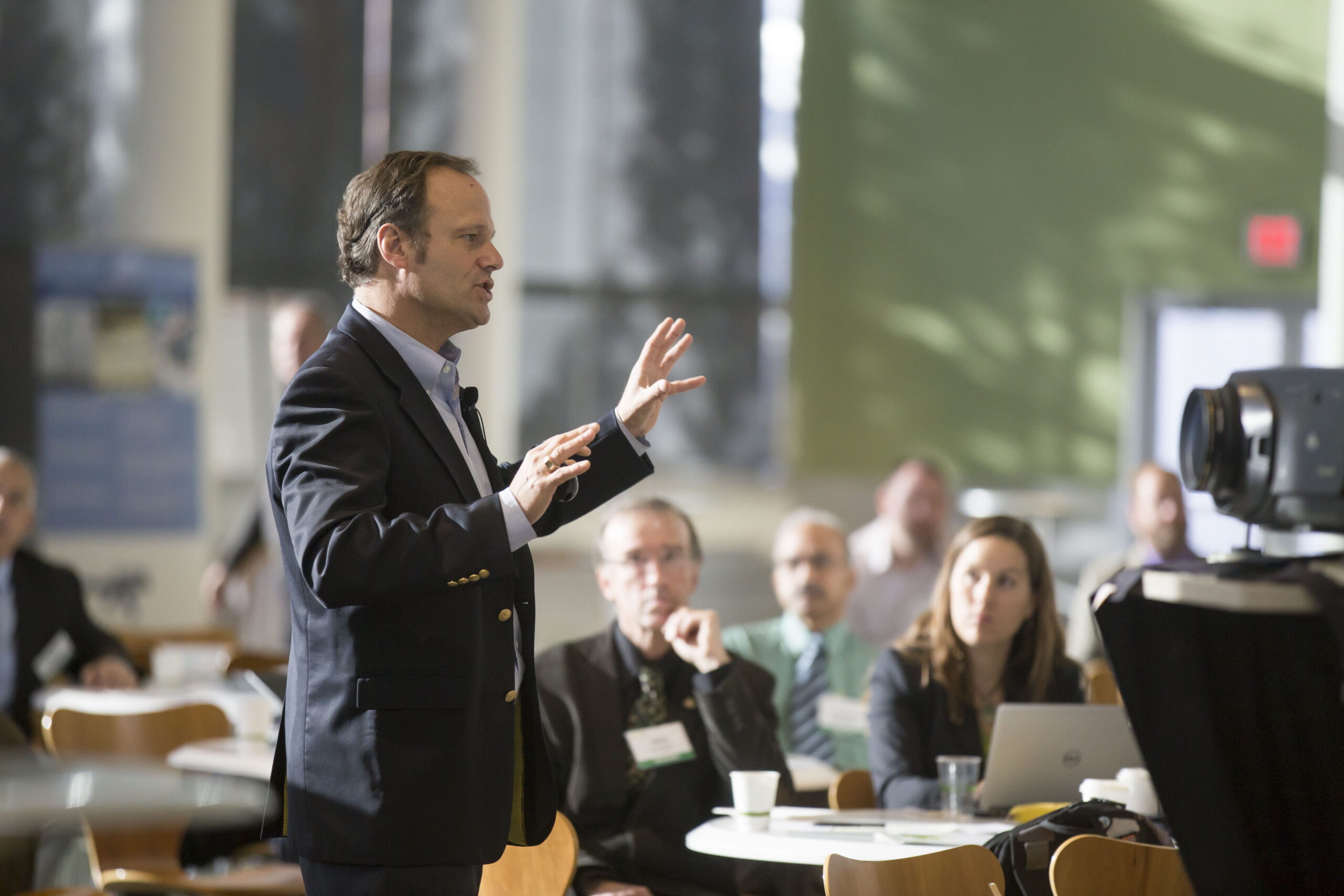
Last month, I watched a senior sales director apologise before delivering her quarterly presentation. “I’m sorry,” she said, “I’m just not a natural speaker.”
She then proceeded to give one of the most insightful, data-rich presentations I’d seen all year. Her analysis was brilliant. Her recommendations were spot-on. But she delivered it all with her eyes glued to her notes, her voice barely above a whisper, her body language screaming discomfort.
Afterwards, when I congratulated her on the content, she deflected: “Thanks, but I’ll never be good at this. Some people are just born presenters. I’m not one of them.”
Here’s what frustrates me about that interaction: she’s absolutely wrong. And this myth, that great presenters are born rather than made, is costing talented professionals like her career opportunities, closed deals, and the ability to make the impact they’re capable of.
Let me tell you why the myth of the “natural speaker” is not just wrong, it’s actively harmful.
The Dangerous Lie We Tell Ourselves
When you watch a TED speaker command the stage with apparent effortlessness, or see your colleague breeze through a client presentation with confidence and charisma, it’s easy to assume they possess some innate gift you lack.
This assumption feels logical. After all, we see the polished performance. We don’t see the hours of preparation behind it. We don’t see the failures that came before. We don’t see the systematic techniques they’ve learned and practiced.
The myth of natural ability creates a devastating mental shortcut: “They’re naturally good at this. I’m not. Therefore, I can’t improve.”
This belief becomes a self-fulfilling prophecy. If you think presentation skills are a fixed trait you either have or don’t have, you won’t invest the time and effort needed to develop them. You’ll avoid presentation opportunities. You’ll accept “adequate” as your ceiling. You’ll watch others advance while you stay stuck.
What Research Actually Tells Us About “Natural” Speakers
The science is unequivocal: presentation skills are learned, not inherited.
K. Anders Ericsson, the late Swedish psychologist whose research revolutionised our understanding of expertise, demonstrated through decades of study that what appears to be natural talent is actually the result of deliberate practice. In his influential 1993 paper “The Role of Deliberate Practice in the Acquisition of Expert Performance,” Ericsson and his colleagues found that exceptional performers across domains, from music to sport to public speaking, achieved mastery through structured, focused practice rather than innate ability.
Ericsson’s research on expert violinists revealed a crucial insight: those who seemed “naturally talented” had simply accumulated more hours of deliberate practice. By age 20, the elite violinists had practised an average of 10,000 hours, but as Ericsson himself noted, “they were nowhere near masters” at that point. The key wasn’t the magic number of hours but the quality and intentionality of practice.
This principle extends directly to public speaking. Research compiled by Michael J. Howe and colleagues concluded that “differences in early experiences, preferences, opportunities, habits, training, and practice are the real determinants of excellence” in any skill, including communication.
When researchers study “natural” presenters, they consistently find that these individuals have simply accumulated more practice opportunities, often unconsciously. They may have:
- Grown up in environments that encouraged speaking (families that valued dinner table conversation, involvement in debating or drama)
- Held roles that required frequent presentations, giving them more repetitions
- Received early positive feedback that motivated them to present more often
- Developed effective techniques through trial and error over many years
None of these factors are about genetics. They’re about exposure, practice, and learning. As psychologist Scott Barry Kaufman puts it bluntly: “There is no such thing as innate talent.”
The Four Elements That Create “Natural” Presenting
When you break down what makes someone appear to be a natural speaker, you discover it’s not magic. It’s a combination of four learnable elements:
1. Technical Knowledge
Every presenter who looks natural has learned specific techniques, whether consciously or unconsciously. They know how to:
- Structure content for maximum impact
- Use vocal variety to maintain interest
- Employ body language that projects confidence
- Make effective eye contact
- Handle questions with composure
These are teachable skills, not innate talents. In the GoTime Framework, we break these down into six systematic stages that anyone can learn.
2. Preparation Rituals
“Natural” speakers have developed pre-presentation routines that put them in peak performance state. They might:
- Use specific breathing exercises to manage anxiety
- Visualise success before presenting
- Practice vocal warm-ups
- Review their core message repeatedly
- Arrive early to familiarise themselves with the space
These rituals aren’t mysterious. They’re deliberate practices that regulate the nervous system and prime the brain for performance.
3. Mental Frameworks
Confident presenters have learned to reframe presentation situations in empowering ways. Instead of thinking “Everyone will judge me,” they think “I have valuable information to share.” Instead of “I’m nervous,” they think “I’m energised.”
This cognitive reframing isn’t personality-based. It’s a learned mental skill that transforms the same physiological response from debilitating to energising.
4. Accumulated Practice
Perhaps most importantly, people who appear naturally talented have simply presented more often. They’ve had more opportunities to fail, adjust, and improve.
Malcolm Gladwell’s “10,000-hour rule” may be oversimplified, but the core insight holds: mastery comes through repetition. The presenter who looks effortless has likely given hundreds of presentations. You’re comparing your tenth attempt to their thousandth.
Why “Natural Talent” Thinking Damages Your Growth
When you attribute someone’s presentation success to natural ability, you rob yourself of the possibility of improvement. This fixed mindset prevents you from:
Taking Risks: If you think you lack the talent, you’ll avoid high-visibility presentation opportunities, which means fewer chances to practice and improve.
Learning From Failure: When things go wrong, you’ll blame your lack of natural ability rather than identifying specific skills to develop.
Investing in Development: Why would you invest time in presentation skills training if you believe the skill is innate?
Recognising Progress: Small improvements go unnoticed because you’re comparing yourself to an impossible standard of “natural” perfection.
This mindset doesn’t just limit your presentation skills. It limits your career.
The Growth Mindset Alternative
The antidote to the natural speaker myth is simple but profound: recognise that presentation skills are learnable systems, not magical gifts.
Every element of effective presenting can be broken down, studied, and practised:
- Nervous before presenting? Learn breathwork techniques and cognitive reframing.
- Struggle with structure? Master proven organisational patterns.
- Boring delivery? Develop vocal variety through deliberate practice.
- Weak body language? Study and practice purposeful gestures and movement.
- Can’t handle questions? Learn systematic approaches to managing Q&A.
None of this requires talent. It requires commitment to learning and practice.
The Evidence: Transformation Stories
I’ve witnessed countless “non-natural” speakers transform into confident, compelling presenters. The sales director who couldn’t make eye contact and now leads client presentations with ease. The engineer who read every word from slides and now presents complex technical concepts with clarity and engagement. The executive who avoided speaking opportunities and now volunteers to present at industry conferences.
None of these people discovered hidden natural talent. They learned systematic techniques, practised deliberately, and built confidence through successful repetitions.
The transformation wasn’t about becoming someone else. It was about developing specific, teachable skills that allowed their authentic expertise to shine through.
Your Path Forward
If you’ve been telling yourself you’re not a natural speaker, I invite you to retire that story today.
Replace it with a more accurate and empowering one: “I haven’t yet developed presentation skills through systematic training and practice.”
That’s not a statement of limitation. It’s a statement of possibility.
Every presenter you admire started where you are now, uncertain, nervous, convinced others had something they lacked. The difference is they committed to the work of learning.
You can make the same commitment. Not by trying to become someone you’re not, but by systematically developing the skills that will allow you to show up as your best self when it matters most.
What Systematic Development Looks Like
Developing presentation skills isn’t about attending one workshop and hoping for transformation. It’s about:
- Learning proven frameworks: Understanding the systematic approach successful presenters use – like our Go Time framework
- Practising deliberately: Focusing on specific skills with targeted practice
- Getting feedback: Identifying blind spots and areas for improvement
- Repeating: Building competence through consistent application
This is exactly what comprehensive presentation skills training provides. Not magic formulas or personality transplants, but teachable techniques you can learn, practice, and master.
The Bottom Line
The myth of the natural speaker is comforting because it lets you off the hook. “I’m just not wired that way,” feels like an acceptable explanation for avoiding the discomfort of growth.
But it’s also limiting because it closes the door on possibility.
The truth is more challenging and more liberating: presentation skills are learnable. The presenter you want to become is accessible through systematic development. The confidence, clarity, and impact you’re capable of are within reach.
Not because you’ll discover hidden natural talent. But because you’ll develop real, practical skills through dedicated practice.
The question isn’t whether you have what it takes. You do. The question is whether you’re willing to do what it takes.
Your presentations don’t have to be perfect. They just have to be prepared. And preparation isn’t about talent. It’s about training.
Ready to move beyond the myth and into systematic skill development? Explore the complete Ultimate 2026 Guide to Presentation Skills Training in South Africa to understand the proven framework that makes presenting learnable for everyone.
About GoTime Presentation Skills
GoTime specialises in transforming South African professionals into confident, compelling presenters through systematic training based on the GoTime Framework. Founded by Gary Tintinger, multi-award-winning speaker and Southern Africa Champion of Public Speaking, we believe presentation skills aren’t about talent, they’re about training.
Contact us at hello(at)gotime.co.za or visit www.gotime.co.za